


 .
. .
.
Still Not Pregnant After Taking Supplements for Months? Here's Why
You've been taking fertility supplements for months. Maybe six months. Maybe a year. You did the research, you bought the good stuff: CoQ10, prenatal with methylfolate, maybe an omega-3. You're doing everything right, and it's not working.
"The most common reason fertility supplements aren't working isn't that supplements don't work. It's that you're addressing the wrong underlying factor. Those are very different problems with very different solutions."
The Most Common Reason Supplements Aren't Working
You're addressing the wrong underlying factor. This sounds simple, but it's the heart of the problem. Fertility supplements are not interchangeable. CoQ10 supports mitochondrial function in eggs. Inositol addresses insulin-related ovarian dysfunction. NAC supports antioxidant capacity and has anti-inflammatory effects. Omega-3s at therapeutic doses address systemic inflammation. These are different mechanisms addressing different problems.
If you're taking CoQ10 and your primary issue is systemic inflammation, you might be doing something useful at the margins, but you're not addressing the thing that's actually holding you back. After 26 years in reproductive health and about 10,000 women seen in clinic, the clearest pattern I see in women who aren't responding to supplements is this: they're taking things that are generally good for fertility without knowing which of the five underlying factors is most active in their specific situation.
KEY INSIGHT
Fertility supplements address different biological mechanisms. Taking supplements that are "generally good for fertility" without knowing which of the five underlying factors is most active in your specific situation is the core reason most protocols fail.
The Five Things That Actually Need to Be Addressed
Poor blood quality and circulation. Uterine blood flow affects implantation. No standard supplement directly and primarily addresses this.
⚠️ IMPORTANT
If circulation to your uterine lining is a primary issue, no amount of antioxidants or egg quality supplements will fix it. This factor requires specific targeted support, and you have to know it's your primary driver first.
Subclinical systemic inflammation. Low-grade inflammation impairs uterine receptivity. Requires specific anti-inflammatory interventions at therapeutic doses, not token antioxidant inclusions.
Blood sugar dysregulation. Glucose volatility disrupts hormonal signaling and ovarian function. Requires inositol, sometimes berberine, not addressed by most fertility supplement blends.
Progesterone insufficiency. Subclinical low progesterone means you can conceive but can't sustain. Not a supplement problem, a clinical problem that requires medical evaluation and possibly progesterone support.
HPA axis disruption from chronic stress. Cortisol-progesterone competition is real. Supplements alone won't fix this without addressing the underlying stress load and sleep patterns driving the dysregulation.
✦ KEEP READING
✦ KEEP READING
Not Sure What Your Body Needs?
Take our free 2-minute quiz and get a personalized supplement protocol built around your specific cycle, hormones, and health signals.
Take the free Score → Explore the App →
The Dose Problem
6x
The gap between a typical CoQ10 supplement dose (100mg) and the dose used in egg quality research (600mg), underdosing is one of the most common and fixable reasons supplements aren't working
Even if you're taking the right things, you might not be taking enough. CoQ10 at 100mg is not the same as CoQ10 at 600mg. Omega-3s at 500mg DHA are not anti-inflammatory in the way that 2g combined EPA+DHA is. Vitamin D at 400 IU won't correct insufficiency. If your protocol was built from reading supplement labels rather than clinical dosing research, your doses might be too low to produce the effects you're hoping for.
📊 WHAT THE RESEARCH SAYS
Clinical research on CoQ10 and egg quality uses doses of 600mg/day or higher, six times the amount found in most over-the-counter fertility supplements. Similarly, the anti-inflammatory threshold for omega-3s requires at least 2g combined EPA+DHA daily; most supplement blends fall far short of this target. Dose matters as much as ingredient selection.
What Actually Moves the Needle
Identify your specific underlying factors. Stop guessing. At Conceivable, your quiz results combined with continuous Halo Ring monitoring, temperature, HRV, sleep, give us an actual picture of which factors are most active in your situation. In our 2014–2016 pilot, a retrospective study with no control group, 22 of 105 sub-fertile participants (21%) reported a pregnancy during the program, and self-reported menstrual cramping fell 28% (p = 0.003). These results justify, but do not replace, a controlled prospective study. That's not a supplement story. That's a systems story.
✦ THE CONCEIVABLE SYSTEM
Personalized Supplements. AI Care Team. The Halo Ring.
Everything your body needs to optimize fertility, built around your information, not someone else's.
Take the free Score → Check Out the App →
Frequently Asked Questions
How do I know if it's the wrong supplement or just not enough time?
After 3–4 months at therapeutic doses targeting your specific primary factor with no change in cycle patterns, monitoring data, or IVF outcomes, that's not a timing issue. That's a targeting issue. The 90-day window is real, but it's not a reason to keep doing the same thing indefinitely if the biology isn't responding. Objective data (Halo Ring patterns, repeat bloodwork, semen analysis) tells you more than waiting does.
Is it possible that supplements just don't work for my situation?
Targeted supplements addressing the right underlying factor, at therapeutic doses, consistently produce measurable biological changes. "Supplements don't work for me" usually means "the supplements I was taking weren't targeting my actual problem at an effective dose." The question to ask isn't whether supplements work, it's which ones, at what doses, for which factor, and whether you're monitoring the response.
What should I do differently if I've been taking supplements for a year with no results?
Stop, reassess, and retest. Get continuous monitoring data rather than relying on symptoms. Identify your primary underlying factor from your specific biology, not from general fertility supplement lists. Rebuild your protocol around that factor at doses that are actually therapeutic. Give the new protocol 90 days with objective monitoring to assess response. The year wasn't wasted, it tells you what doesn't work for your situation, which narrows the field.
Could something other than supplements be the primary issue?
Yes, and this is important. If structural issues (blocked tubes, fibroids, polyps, severe MFI) are the primary driver, supplements won't address those. If progesterone insufficiency is confirmed on testing, clinical progesterone support rather than supplements is the answer. Supplements address the five subclinical biological factors, they don't replace clinical diagnosis and treatment of structural or hormonal pathology.
Should I talk to my RE about my supplement protocol?
Yes, always. Your RE needs to know what you're taking, particularly before any treatment cycle. Some supplements are fine throughout; others your RE may ask you to pause during stimulation or around transfer. Beyond logistics, sharing what you've tried and for how long is useful clinical information that helps your RE understand what ground you've already covered.
How does the Conceivable system actually work?
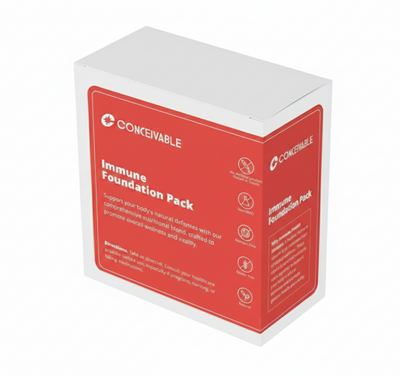
Conceivable combines three things: personalized supplement packs built from your quiz results and health data, an AI care team of 7 specialists (led by Kai, your fertility coordinator) who help you understand your pattern and can suggest a pack, and the Halo Ring for continuous biometric tracking. The system is built on published reproductive-health research and 20 years of clinical practice. It starts at $14.99/month.
How do I know which supplements I actually need?
Take the free 2-minute Conceivable quiz. It analyzes your cycle patterns, energy, stress, digestion, and health history to identify the specific nutrients your body needs, not a generic prenatal, but a protocol built for exactly where you are right now.
Do I need the Halo Ring to use Conceivable?
No. The Halo Ring is optional and adds overnight tracking of temperature, HRV and sleep, which Kai uses to help you understand your pattern and suggest a pack. But the personalized supplement packs and AI care team work without it. The ring is a one-time $250 purchase with no subscription required.
Written by Kirsten Karchmer, founder of Conceivable. She has worked in reproductive health for 26 years, including 20 years in clinical practice, and is a former board-certified reproductive acupuncturist (ABORM) and the author of Seeing Red (Simon & Schuster).
Your Report puts your cycle, energy, sleep and symptoms in context, then shows what may be helping, what may be getting in the way, and where to start.
Get my Report, $89 Educational guidance, not a diagnosis.Kai is your AI fertility coordinator, built from 20 years of clinical practice. She can answer your specific questions right now.
Chat with Kai in the app
