


 .
. .
.
Probiotics and PCOS: What the Gut-Hormone Connection Actually Means
The research on gut microbiome and reproductive hormones has accelerated significantly in recent years, and for women with PCOS specifically, the findings are genuinely interesting. Here's what we actually know about probiotics, prebiotics, and PCOS, and what that means for how you should think about gut health as part of your fertility plan.
"Your gut microbiome affects your estrogen levels, your insulin sensitivity, and your inflammation, all three of which are directly relevant to PCOS."
The Gut-Hormone Connection in PCOS
Three mechanisms link gut health to PCOS specifically:
The estrobolome: A subset of gut bacteria produces beta-glucuronidase, an enzyme that deconjugates estrogen in the gut, essentially recycling estrogens back into circulation rather than allowing them to be excreted. An imbalanced microbiome with excess beta-glucuronidase activity can contribute to estrogen excess, affecting the LH/FSH ratio and androgen dynamics in PCOS.
Insulin sensitivity: Gut microbiome composition directly influences insulin signaling through short-chain fatty acid production, gut barrier integrity, and metabolic endotoxemia (small amounts of bacterial lipopolysaccharide crossing the gut barrier and triggering systemic inflammation). Women with PCOS consistently show reduced microbiome diversity and specific microbiome patterns associated with impaired insulin sensitivity.
Systemic inflammation: Gut dysbiosis is a driver of chronic low-grade inflammation, and inflammation is both a cause and consequence of PCOS. Reducing gut-derived inflammation is a meaningful lever on the overall PCOS picture.
KEY INSIGHT
Gut dysbiosis doesn't just affect digestion, it directly disrupts the estrogen recycling pathway, insulin signaling, and systemic inflammation, making it a core driver of the PCOS hormonal picture rather than a peripheral concern.
60%
of women with PCOS show measurable gut dysbiosis, microbiome differences that are documented and partially responsive to intervention
What Probiotics Can and Can't Do for PCOS
The research on specific probiotic strains for PCOS is early but directionally consistent: multi-strain probiotic supplementation in women with PCOS shows modest improvements in insulin sensitivity, androgen levels, and inflammatory markers in several clinical trials. These effects are real but not dramatic on their own, probiotics are best thought of as part of a comprehensive approach, not a standalone intervention.
Lactobacillus and Bifidobacterium strains are the most studied. The specific strains and combination matter more than the total CFU count (you want the right bacteria, not just the most bacteria). Fermented foods, yogurt, kefir, kimchi, sauerkraut, provide varied probiotic exposure alongside the fiber that feeds those bacteria.
📊 WHAT THE RESEARCH SAYS
Multiple clinical trials of multi-strain probiotic supplementation in women with PCOS have shown statistically significant improvements in fasting insulin, HOMA-IR (a measure of insulin resistance), total testosterone, and inflammatory markers including CRP. The effects are consistent across studies, though modest in magnitude, reinforcing that probiotics are a meaningful component of a comprehensive PCOS protocol, not a standalone treatment.
⚠️ IMPORTANT
Prebiotics, the fiber that feeds beneficial gut bacteria, matter as much as probiotics. Without adequate dietary fiber, probiotic supplements have no substrate to work with. Increasing diverse fiber intake (vegetables, legumes, whole grains) alongside probiotic supplementation creates a more sustainable microbiome improvement than supplements alone.
✦ KEEP READING
✦ KEEP READING
Not Sure What Your Body Needs?
Take our free 2-minute quiz and get a personalized supplement protocol built around your specific cycle, hormones, and health signals.
Take the free Score → Explore the App →
Inositol and the Gut: An Underappreciated Connection
Myo-inositol, the most evidence-backed supplement for PCOS fertility, is produced in significant amounts by gut bacteria from dietary fiber. Women with dysbiotic gut microbiomes may have reduced gut inositol production, compounding the insulin-signaling impairment that drives PCOS. This is one more reason why gut health is relevant to the PCOS picture beyond just inflammation and estrogen metabolism.
"Women with dysbiotic gut microbiomes may have reduced gut inositol production, compounding the insulin-signaling impairment that drives PCOS, which means fixing the gut isn't just about inflammation, it's about restoring the raw materials for hormone balance."
How Conceivable Addresses the Gut-PCOS Connection
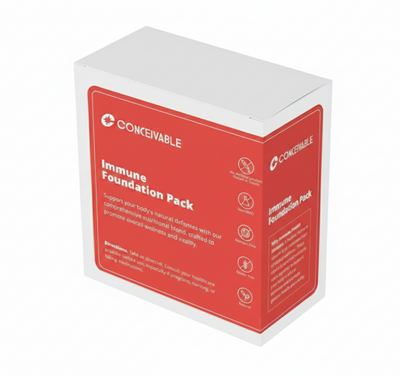
Your Conceivable supplement protocol for PCOS includes targeted probiotic and prebiotic support as part of the complete metabolic approach, alongside inositol, antioxidants, and the other interventions with evidence for PCOS fertility. We don't treat the gut in isolation; we address the five underlying physiological factors together, because they interact. Your tracking over time shows whether your energy, cycle and symptoms are actually improving.
✦ THE CONCEIVABLE SYSTEM
Personalized Supplements. AI Care Team. The Halo Ring.
Everything your body needs to optimize fertility, built around your information, not someone else's.
Take the free Score → Check Out the App →
Frequently Asked Questions
Should I take probiotics if I have PCOS?
Based on current evidence, yes, as part of a broader approach that addresses insulin resistance, diet, and other PCOS drivers. Probiotics alone won't restore ovulation, but they contribute meaningfully to the metabolic environment that PCOS interventions aim to improve. Choose a multi-strain product with documented Lactobacillus and Bifidobacterium strains, and pair it with dietary fiber rather than treating it as a standalone solution.
What's the difference between probiotics and prebiotics?
Probiotics are live bacteria you consume, through supplements or fermented foods, that take up residence in your gut. Prebiotics are the dietary fiber compounds that feed those bacteria once they're there. Both matter. Probiotic supplements without adequate dietary fiber are less effective; many of those bacteria need specific fiber compounds to thrive. The most practical approach is to increase vegetable and legume diversity alongside probiotic supplementation.
Can gut health affect my hormone levels directly?
Yes, the estrobolome directly influences circulating estrogen levels by controlling how much estrogen is recycled versus excreted. Androgens are also partially metabolized in the gut. And insulin sensitivity, which drives androgen production in PCOS, is significantly influenced by gut microbiome composition. Gut health is not peripheral to hormone balance; it's a meaningful direct input.
I've been taking probiotics for months, why aren't I seeing cycle changes?
Probiotics are part of the picture, not the whole picture. For PCOS, the primary driver is insulin resistance, and addressing that requires the combination of dietary changes, inositol supplementation, exercise, and possibly medication, with gut health support as a complementary layer. If you're taking probiotics without addressing blood sugar regulation and androgen excess directly, you're working on one dimension of a multi-dimensional problem.
Are fermented foods as effective as probiotic supplements?
Fermented foods provide diverse bacterial strains and naturally contain prebiotic fiber alongside live cultures, which may make them more effective per serving for microbiome diversity than single or even multi-strain supplements. They're not interchangeable with targeted probiotic supplements for specific strain needs, but including fermented foods as a regular part of your diet provides microbiome benefits that supplements don't fully replicate. The ideal approach is both.
How does the Conceivable system actually work?
Conceivable combines three things: personalized supplement packs built from your quiz results and health data, an AI care team of 7 specialists (led by Kai, your fertility coordinator) who help you understand your pattern and can suggest a pack, and the Halo Ring for continuous biometric tracking. The system is built on published reproductive-health research and 20 years of clinical practice. It starts at $14.99/month.
How do I know which supplements I actually need?
Take the free 2-minute Conceivable quiz. It analyzes your cycle patterns, energy, stress, digestion, and health history to identify the specific nutrients your body needs, not a generic prenatal, but a protocol built for exactly where you are right now.
Do I need the Halo Ring to use Conceivable?
No. The Halo Ring is optional and adds overnight tracking of temperature, HRV and sleep, which Kai uses to help you understand your pattern and suggest a pack. But the personalized supplement packs and AI care team work without it. The ring is a one-time $250 purchase with no subscription required.
Written by Kirsten Karchmer, founder of Conceivable. She has worked in reproductive health for 26 years, including 20 years in clinical practice, and is a former board-certified reproductive acupuncturist (ABORM) and the author of Seeing Red (Simon & Schuster).
Your Report puts your cycle, energy, sleep and symptoms in context, then shows what may be helping, what may be getting in the way, and where to start.
Get my Report, $89 Educational guidance, not a diagnosis.Kai is your AI fertility coordinator, built from 20 years of clinical practice. She can answer your specific questions right now.
Chat with Kai in the app
