


Your Prenatal Vitamin Isn't Doing Enough — Here's What's Missing
I have nothing against prenatal vitamins. Folic acid matters. Iron matters. Iodine matters. But I've watched too many women spend two, three, four years taking a prenatal vitamin and getting nowhere, convinced they were doing everything right, when what they were actually doing was addressing the floor — the absolute minimum baseline — while leaving their actual biological issues completely untouched.
"A prenatal vitamin is not a fertility protocol. It was designed to prevent neural tube defects in a fetus that already exists."
It was not designed to optimize the underlying factors that determine whether you can conceive and sustain a pregnancy. Those are two completely different things.
What a Prenatal Vitamin Actually Does
A standard prenatal covers the nutrients where deficiency would directly harm fetal development: folic acid, iron, calcium, iodine, vitamin D, B12. These are important. If you're trying to conceive, you should be taking them.
But here's what they don't address: mitochondrial function in your eggs. Systemic inflammation creating a hostile implantation environment. Blood sugar volatility disrupting your hormonal signaling. HPA axis dysregulation suppressing progesterone production. Circulation to your uterine lining. These are the five underlying factors I see driving unexplained infertility in the majority of my patients. A prenatal vitamin doesn't touch any of them.
KEY INSIGHT
The five underlying factors driving unexplained infertility — mitochondrial function, systemic inflammation, blood sugar volatility, HPA axis dysregulation, and uterine circulation — are not addressed by any standard prenatal vitamin formula. Addressing the floor is not the same as optimizing for conception.
The Nutrients That Actually Move the Needle
After 25 years and 10,000+ credited pregnancies, here's what I see consistently: the women who respond best aren't the ones who found the best prenatal vitamin. They're the ones who addressed their specific underlying issues with the specific nutrients those issues require.
CoQ10 (as ubiquinol): Mitochondrial function declines with age. Eggs are the most mitochondria-dependent cells in your body. CoQ10 supports the energy production your eggs need for healthy division and development. The dose matters — most commercial supplements are too low to be meaningful. And ubiquinol is significantly more bioavailable than ubiquinone.
⚠️ IMPORTANT
Most prenatal vitamins include CoQ10 at 50–100mg. The egg quality research used 400–600mg daily. These are not equivalent — and taking a prenatal that "includes CoQ10" does not mean you are getting a therapeutic dose.
Methylfolate, not just folic acid: A significant percentage of women have MTHFR variants that impair their ability to convert synthetic folic acid to the active form. If you have this variant and you're only taking folic acid, you're not getting what you think you're getting.
Inositol (myo and D-chiro): If blood sugar dysregulation is driving your fertility issues — which it does in more women than standard testing reveals — inositol is one of the most effective tools available. It supports insulin sensitivity and directly affects ovarian function and egg quality.
Vitamin D (therapeutic dose): Most prenatal vitamins include 400–600 IU of vitamin D. Most women trying to conceive who aren't optimizing are deficient, and 400 IU won't fix that. Get your levels tested. Optimize accordingly.
50–70 ng/mL
Optimal vitamin D range for fertility — most women testing below 30 ng/mL without targeted supplementation
Omega-3 fatty acids (EPA/DHA): Systemic inflammation is one of the most common and most underaddressed factors in infertility. Omega-3s at therapeutic doses are among the best-studied anti-inflammatory interventions available. Most prenatal vitamins either don't include them or include doses too low to be anti-inflammatory.
✦ KEEP READING
✦ KEEP READING
✦ KEEP READING
Not Sure What Your Body Needs?
Take our free 2-minute quiz and get a personalized supplement protocol built around your specific cycle, hormones, and health signals.
Take the Quiz → Explore the App →
The Problem With Generic Supplement Advice
Reading articles about fertility supplements is not the same as having a protocol. Knowing that CoQ10 supports egg quality doesn't tell you whether CoQ10 is the highest-priority intervention for your specific biology. Maybe it is. But maybe your most pressing issue is inflammation, or blood sugar, or progesterone. If you're spending your supplement budget on the wrong things, you're not making progress.
📊 WHAT THE RESEARCH SAYS
Male factor issues are present in roughly half of all infertility cases, yet supplementation protocols are overwhelmingly focused on women. Sperm takes 74 days to develop — meaning both partners optimizing simultaneously, for the full 90-day window, produces meaningfully better outcomes than a one-sided approach. (Agarwal et al., World Journal of Men's Health, 2021)
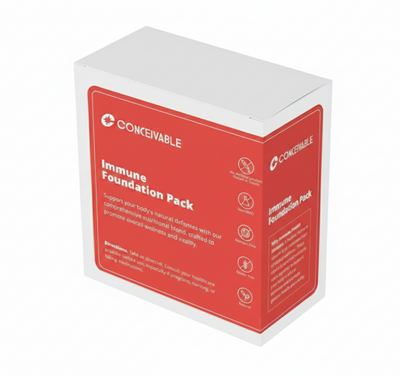
This is exactly why Conceivable starts with your quiz. Your responses, combined with your ongoing Halo Ring data — BBT, HRV, glucose, sleep — give us a picture of which of the five underlying factors are most active in your situation. Your supplement protocol is built from that picture, not from a generic recommendation list. Kai monitors your data over time and flags when patterns shift. As your biology changes, your protocol updates.
✦ THE CONCEIVABLE SYSTEM
Personalized Supplements. AI Care Team. The Halo Ring.
Everything your body needs to optimize fertility — built around your data, not someone else's.
Take the Quiz → Check Out the App →
Frequently Asked Questions
Can I just take a better prenatal vitamin instead of multiple supplements?
A better prenatal is a better starting point, but it's still a starting point. Comprehensive prenatal formulas face a structural constraint: to keep the product manageable and affordable, they include many ingredients at doses that are often sub-therapeutic. A prenatal that includes CoQ10 at 100mg and inositol at 200mg is better than one without — but it's not the same as addressing those factors at the doses the clinical research actually used.
How do I know if my prenatal vitamin is actually working?
For basic nutritional insurance, blood tests for vitamin D, B12, iron, and folate can confirm adequacy. For fertility-specific outcomes, the feedback loop is harder to measure without continuous monitoring. If you've been taking a prenatal for 6+ months without results, that's meaningful information — it's not evidence to take more of the same thing.
Does it matter when I start taking prenatal vitamins before trying to conceive?
The recommendation is at least 3 months before trying to conceive for folate — but for fertility optimization, the 90-day window applies to everything. Egg maturation takes approximately 90 days. The biological environment you create in the next three months is what the eggs you ovulate this cycle are developing in right now. Start earlier, not later.
Are there prenatal vitamins that actually include fertility-specific nutrients at useful doses?
A few — FH Pro for Women is one of the better comprehensive formulas, with methylfolate, inositol, NAC, and CoQ10 at doses that are at least meaningful. It's still not a personalized protocol, but it's a better-designed baseline than most. The limitation is that "better than average" isn't the same as "right for your specific situation."
Should both partners be taking supplements before trying to conceive?
Yes, and this is consistently underemphasized. Male factor issues are present in roughly half of all infertility cases. Sperm takes 74 days to develop — meaning his biology right now is producing the sperm you'll be working with in 2–3 months. Both partners optimizing simultaneously, for the full 90-day window, produces meaningfully better outcomes than focusing only on one side.
How does the Conceivable system actually work?
Conceivable combines three things: personalized supplement packs built from your quiz results and health data, an AI care team of 7 specialists (led by Kai, your fertility coordinator) who adjust your protocol as your body changes, and the Halo Ring for continuous biometric tracking. The system is built on 240,000+ clinical data points and 20 years of practice. It starts at $15/month.
How do I know which supplements I actually need?
Take the free 2-minute Conceivable quiz. It analyzes your cycle patterns, energy, stress, digestion, and health history to identify the specific nutrients your body needs — not a generic prenatal, but a protocol built for exactly where you are right now.
Do I need the Halo Ring to use Conceivable?
No. The Halo Ring is optional and adds continuous tracking of BBT, HRV, sleep, and blood glucose — which Kai uses to fine-tune your protocol in real time. But the personalized supplement packs and AI care team work without it. The ring is a one-time $250 purchase with no subscription required.
Written by Kirsten Karchmer, reproductive medicine practitioner with 25 years of clinical experience and 10,000+ credited pregnancies, and author of The Road to Better Fertility.
Kai is your AI fertility coordinator — trained on 25 years of clinical data. She can answer your specific questions right now.
Chat with Kai →