



 .
. .
.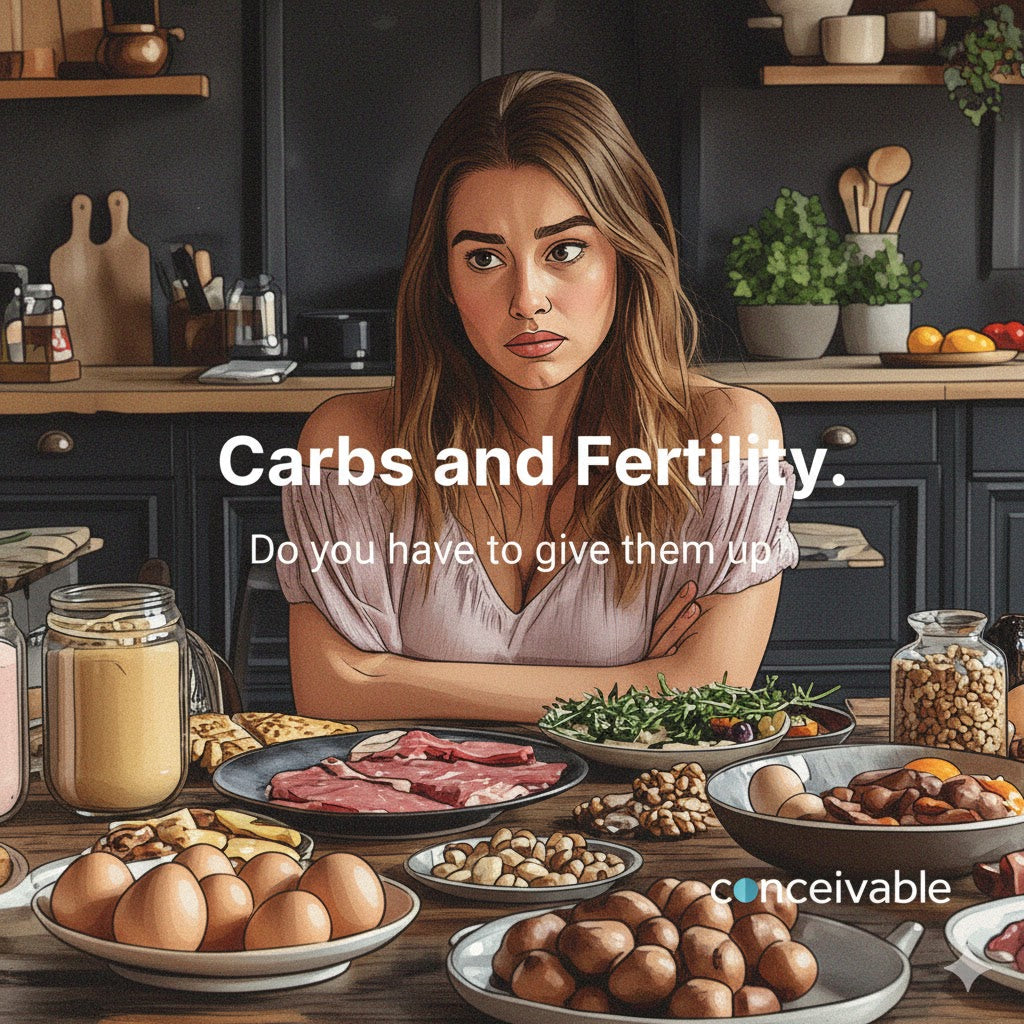
Carbs and Fertility: Do You Really Need to Give Them Up?
Carbohydrates have become the villain in nearly every fertility diet conversation, and the advice to "cut carbs" gets handed out so freely that most women trying to conceive assume eliminating them is a prerequisite. The reality is more nuanced, and more useful: not all carbohydrates affect fertility the same way, and the type, quality, and timing of carbohydrates in your diet matters far more than total elimination.
Why Carbohydrates Matter for Reproductive Function
Carbohydrates are the primary driver of blood sugar and insulin response, and insulin is deeply entangled with reproductive hormone signaling. When you eat refined carbohydrates (white bread, sugar, processed foods), blood glucose rises rapidly, triggering a surge of insulin. Chronically elevated insulin suppresses sex hormone-binding globulin (SHBG), which normally binds and regulates estrogen and testosterone. Lower SHBG means higher free androgens circulating in the body, a pattern consistently associated with anovulation, irregular cycles, and polycystic ovary syndrome (PCOS).
Insulin also directly stimulates ovarian theca cells to produce more testosterone, and it reduces the liver's conversion of androgens to estrogens. The result is a hormonal environment that is actively hostile to ovulation and implantation. This is not about carbs being inherently bad, it's about what rapid glucose spikes do to hormonal signaling over time.
KEY INSIGHT
This is not about carbs being inherently bad, it's about what rapid glucose spikes do to hormonal signaling over time. Chronically elevated insulin creates a hormonal environment that is actively hostile to ovulation and implantation.
The Carbohydrates That Support Fertility
Complex carbohydrates, legumes, whole grains, vegetables, and low-glycemic fruits, digest more slowly, producing a gradual rise in blood sugar rather than a spike. This keeps insulin levels stable and protects the hormonal environment ovulation depends on. The fiber in these foods also binds excess estrogen in the gut and supports its excretion, which is important for women dealing with estrogen dominance, heavy periods, or endometriosis.
Research from the Nurses' Health Study II found that women who substituted low-glycemic carbohydrates for high-glycemic ones had a significantly lower risk of ovulatory infertility. Fiber intake specifically was associated with more regular cycles and lower risk of endometrial conditions. These aren't marginal effects, they're meaningful clinical signals.
📊 WHAT THE RESEARCH SAYS
The Nurses' Health Study II found that women who substituted low-glycemic carbohydrates for high-glycemic ones had a significantly lower risk of ovulatory infertility. Fiber intake was independently associated with more regular cycles and lower risk of endometrial conditions.
The Carbohydrates That Harm Fertility
Refined carbohydrates, white flour products, sugary beverages, pastries, white rice, and most processed foods, drive the insulin dysregulation described above. Fructose, in particular the high-fructose corn syrup found in sweetened beverages and packaged foods, is metabolized primarily by the liver, where it promotes fatty liver, systemic inflammation, and insulin resistance without the immediate satiety signals that other sugars produce. Studies have linked high fructose intake to lower IVF success rates and poorer embryo quality.
Trans fats, often paired with refined carbohydrates in processed foods, are independently associated with a two-fold increase in ovulatory infertility risk. Elimination of these, not complex carbohydrates, is the most evidence-supported dietary change for fertility.
2×
Increased ovulatory infertility risk associated with trans fat consumption, often found paired with refined carbohydrates in processed foods
✦ KEEP READING
- CoQ10 and Fertility: Every Benefit Explained (With the Caveats You Actually Need) →
- What to Eat During the Two-Week Wait (And What to Stop Obsessing Over) →
- Signs You're Eating Too Much Sugar: And What It's Doing to Your Fertility →
- Foods That Make Anxiety Worse When You're Trying to Conceive: And What to Eat Instead →
✦ KEEP READING
- CoQ10 and Fertility: Every Benefit Explained (With the Caveats You Actually Need) →
- What to Eat During the Two-Week Wait (And What to Stop Obsessing Over) →
- Signs You're Eating Too Much Sugar: And What It's Doing to Your Fertility →
- Foods That Make Anxiety Worse When You're Trying to Conceive: And What to Eat Instead →
Not Sure What Your Body Needs?
Take our free 2-minute quiz and get a personalized supplement protocol built around your specific cycle, hormones, and health signals.
Take the free Score → Explore the App →
Carbohydrates and PCOS
For women with PCOS specifically, carbohydrate quality is one of the most clinically significant dietary levers available. PCOS involves underlying insulin resistance in 50–80% of cases, even in lean women. When insulin levels are chronically elevated, LH surges become erratic, follicle development is disrupted, and ovulation fails. Reducing glycemic load, not eliminating carbohydrates entirely, consistently improves menstrual regularity, reduces androgen levels, and restores ovulation in PCOS patients across multiple clinical studies.
A low-glycemic index diet in women with PCOS has been shown to improve menstrual cyclicity more effectively than a conventional healthy diet, even with similar caloric intake. The glycemic index of carbohydrate foods, not their presence or absence, is what drives the clinical difference.
"The glycemic index of carbohydrate foods, not their presence or absence, is what drives the clinical difference, especially for women with PCOS."
What About Low-Carb and Ketogenic Diets?
Very low-carbohydrate diets can improve insulin sensitivity and reduce androgens in the short term, and some women with PCOS report improved cycle regularity on a ketogenic approach. However, extreme carbohydrate restriction also suppresses thyroid function, reduces leptin (which is required for hypothalamic GnRH pulsatility), and can impair HPA axis function, all of which affect ovulation and cycle regularity. Long-term ketogenic dieting in women of reproductive age has been associated with disrupted LH pulsatility and secondary amenorrhea in some cases.
The evidence supports a middle path: a whole-food diet that prioritizes low-glycemic, high-fiber complex carbohydrates while eliminating refined grains, sugar, and processed foods. This is not carbohydrate elimination, it is carbohydrate quality optimization.
⚠️ IMPORTANT
Long-term ketogenic dieting in women of reproductive age has been associated with suppressed thyroid function, reduced leptin, disrupted LH pulsatility, and secondary amenorrhea in some cases. Extreme carbohydrate restriction is not the same as carbohydrate quality optimization.
Practical Carbohydrate Choices for Fertility
The carbohydrates most consistently associated with reproductive health include: lentils and legumes (high fiber, moderate glycemic index, rich in folate), sweet potatoes and winter squash (complex carbs with antioxidants), quinoa and oats (complete amino acids and sustained energy), leafy greens and cruciferous vegetables (low glycemic, high in indole-3-carbinol for estrogen metabolism), and low-sugar fruits like berries, apples, and pears. Pairing any carbohydrate source with protein or healthy fat further blunts the glycemic response and supports more stable insulin levels throughout the day.
The Bottom Line
You do not need to give up carbohydrates to optimize your fertility. You need to give up the specific carbohydrates that drive insulin dysregulation, refined grains, sugar, sweetened beverages, and processed foods. The complex carbohydrates in whole plant foods actively support hormone balance, estrogen clearance, and ovulatory function. Treating all carbohydrates as identical is a nutritional oversimplification that leads women to unnecessarily restrict foods that support their reproductive health.
✦ THE CONCEIVABLE SYSTEM
Personalized Supplements. AI Care Team. The Halo Ring.
Everything your body needs to optimize fertility, built around your information, not someone else's.
Take the free Score → Check Out the App →
Frequently Asked Questions
Do I need to go low-carb to improve my fertility?
No. The evidence supports reducing glycemic load, not eliminating carbohydrates. Women who swap refined carbohydrates for low-glycemic, high-fiber options like legumes, vegetables, and whole grains consistently show improvements in ovulatory function. Total carbohydrate elimination is not only unnecessary for most women, it may cause hormonal disruption through thyroid suppression and reduced leptin signaling.
Are carbohydrates bad for PCOS?
Refined carbohydrates are problematic for PCOS because they exacerbate the insulin resistance that underlies the condition in 50–80% of cases. However, low-glycemic carbohydrates, legumes, vegetables, and whole grains, are not only safe for women with PCOS but actively supportive. A low-glycemic index diet has been shown to improve menstrual cyclicity in PCOS more effectively than a standard healthy diet, even at the same calorie level.
Which carbohydrate foods are best for fertility?
The most fertility-supportive carbohydrate foods include lentils and legumes (rich in fiber and folate), sweet potatoes, quinoa, oats, cruciferous and leafy vegetables, and low-sugar fruits like berries and apples. Pairing these with protein or healthy fat further stabilizes the insulin response and supports the hormonal balance ovulation depends on.
How does the Conceivable system actually work?
Conceivable combines three things: personalized supplement packs built from your quiz results and health data, an AI care team of 7 specialists (led by Kai, your fertility coordinator) who help you understand your pattern and can suggest a pack, and the Halo Ring for continuous biometric tracking. The system is built on published reproductive-health research and 20 years of clinical practice. It starts at $14.99/month.
How do I know which supplements I actually need?
Take the free 2-minute Conceivable quiz. It analyzes your cycle patterns, energy, stress, digestion, and health history to identify the specific nutrients your body needs, not a generic prenatal, but a protocol built for exactly where you are right now.
Do I need the Halo Ring to use Conceivable?
No. The Halo Ring is optional and adds overnight tracking of temperature, HRV and sleep, which Kai uses to help you understand your pattern and suggest a pack. But the personalized supplement packs and AI care team work without it. The ring is a one-time $250 purchase with no subscription required.
Written by Kirsten Karchmer, founder of Conceivable. She has worked in reproductive health for 26 years, including 20 years in clinical practice, and is a former board-certified reproductive acupuncturist (ABORM) and the author of Seeing Red (Simon & Schuster).
Your Report puts your cycle, energy, sleep and symptoms in context, then shows what may be helping, what may be getting in the way, and where to start.
Get my Report, $89 Educational guidance, not a diagnosis.Kai is your AI fertility coordinator, built from 20 years of clinical practice. She can answer your specific questions right now.
Chat with Kai in the app
