


 .
. .
.
What I Learned From Looking at Tens of Thousands of BBT Charts: What Your Basal Body Temperature Can Tell You About Your Chances of Getting Pregnant.
In my 20 years of clinical practice, I've reviewed more than 250,000 BBT charts. I quickly started recognizing distinct relationships between the waves of a woman's BBT chart and her ovulation patterns, quality and quantity of cervical discharge, estrogen and progesterone levels, FSH, egg quality, and likelihood to present with PMS. In fact, with one look at a BBT chart, I can usually pinpoint the major reasons a woman is struggling to get pregnant.
While many women keep BBT charts as a way to predict ovulation, there's actually SOOOOOO much more a BBT chart can tell you, and when ovulation is occurring is usually the least important.
Now, when I view a woman's BBT chart, there are a few things I immediately look for as warning signs of fertility issues:
KEY INSIGHT
With one look at a BBT chart, an experienced clinician can usually identify the major reasons a woman is struggling to get pregnant, because temperature patterns are a direct window into hormone levels, egg quality, and uterine receptivity.
Issues in the Follicular Phase
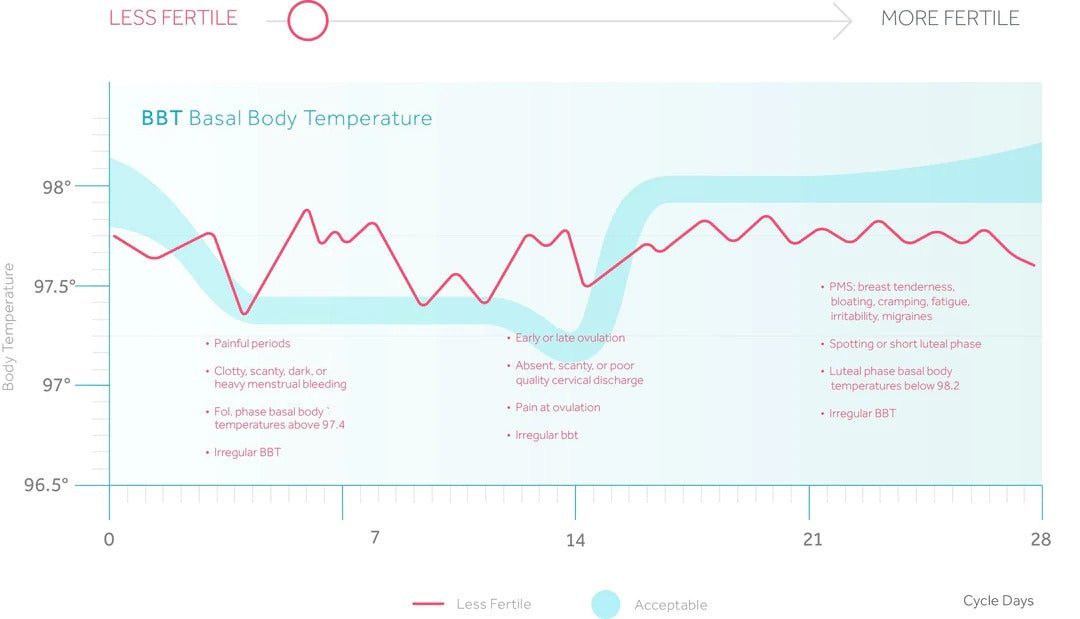
The follicular phase is the part of your menstrual cycle beginning with your period and ending with ovulation (ideally cycle day 1 through cycle day 14). In my clinical experience, follicular temperatures in healthy cycles usually stay below about 97.5° F, though every body and thermometer is a little different.
When temperatures are cooler, we see an association with better FSH levels, better quality and quantity of cervical discharge, and better egg quality. All promising indicators for a fertile cycle.
As temperatures climb closer to 98° during the follicular phase, less cervical discharge is produced, elevations in FSH can be observed, and symptoms like hot flashes and night sweats will appear. All of these signal hormone imbalances and are problematic to fertility.
⚠️ IMPORTANT
If your follicular phase temperatures are consistently approaching 98° F, especially alongside symptoms like hot flashes or night sweats, this is a sign of hormone imbalance that can significantly reduce your chances of conception. Don't ignore these signals.
Issues in the Luteal Phase
After ovulation occurs (on or around cycle day 14), the luteal phase begins. In my clinical experience, luteal temperatures in healthy cycles usually reach about 98.2° F or higher, clearly above your follicular temperatures.
Temperatures above 98° indicate ideal progesterone levels. Progesterone is a key hormone for allowing implantation to occur in the uterus and for preventing early pregnancy loss. I have observed an extremely close association with low luteal phase temperatures and recurrent pregnancy loss.
In my clinic, I noticed that women whose luteal temperatures stayed below 98 degrees before conception seemed to miscarry more often. That was an observation from my practice, not a published study.
📊 WHAT THE RESEARCH SAYS
Progesterone is essential for successful implantation and maintaining early pregnancy. Whether a short or low luteal phase on its own causes infertility or repeat miscarriage is still debated, and the American Society for Reproductive Medicine says it hasn't been proven (ASRM, 2026). In my 20 years of clinical practice with about 10,000 women, luteal temperatures and pregnancy outcomes seemed closely linked, but that's an observation, not a published study.
✦ KEEP READING
✦ KEEP READING
Not Sure What Your Body Needs?
Take our free 2-minute quiz and get a personalized supplement protocol built around your specific cycle, hormones, and health signals.
Take the free Score → Explore the App →
Stop Tracking BBT And Start Taking Charge Of It
Here's some great news: your fertility is not a fixed point. Fertility can change over time and you're not stuck with a crummy BBT chart or a crummy, painful menstrual cycle.
Pay attention to the warning signs above as you track your BBT throughout the month. If you do notice any of these problematic temperature patterns pop up in your chart, working with an integrated system like Conceivable is a great, natural way to regulate your BBT and boost your fertility.
"Your fertility can change. First, you have to understand what the problems are, how they are related, and then make a plan to fix them."
Knowing how to read your BBT chart for potential issues is a fantastic way to take charge of your reproductive health and conception. If you're still not sure what a healthy cycle looks like, here's a great graphic.
Like I said before, your fertility can change. First, you have to understand what the problems are, how they are related and then make a plan to fix them.
While I did this for my patients for 2 decades I have been working on a way to help more women and people with periods understand the underlying causes of their fertility problems. I am developing an assessment that helps me collect all the data in a super organized way so I can then give you your fertility score, and customize a program to help you improve your fertility month over month. This is precisely what I did for more than 10k patients but now it is about 1/100 the price of seeing me in my clinic.
If you would like to learn more, click here to meet your new AI personalized fertility coach, Kai. For the price of a pregnancy test, you can get her help to figure out the underlying issues why you are struggling to get or stay pregnant and she will help you create a highly personalized plan to repair them!
Looking forward to seeing you there.
Remember, there is hope.
✦ THE CONCEIVABLE SYSTEM
Personalized Supplements. AI Care Team. The Halo Ring.
Everything your body needs to optimize fertility, built around your information, not someone else's.
Take the free Score → Check Out the App →
Frequently Asked Questions
What BBT temperature is considered normal in the follicular phase?
During the follicular phase (cycle day 1 through ovulation), in my clinical experience temperatures usually stay below about 97.5° F. Temperatures creeping toward 98° F during this phase can signal rising FSH, reduced cervical mucus, and hormone imbalances that may impact egg quality and fertility.
What does a low luteal phase temperature mean for pregnancy?
In my clinical experience, luteal phase temperatures usually reach about 98.2° F or higher. Temperatures below 98° in the luteal phase are associated with lower progesterone levels, a hormone critical for implantation and maintaining early pregnancy. In my clinic, women with luteal temperatures below 98° seemed to miscarry more often, though that's an observation from my practice, not a published study.
Can BBT patterns actually be improved?
Yes. Fertility is not a fixed point. BBT patterns reflect underlying hormone balance, and those hormones can be influenced through targeted nutrition, supplementation, and lifestyle changes. Identifying the problematic pattern is the first step, then building a personalized plan to address the root cause is what moves the needle.
How does the Conceivable system actually work?
Conceivable combines three things: personalized supplement packs built from your quiz results and health data, an AI care team of 7 specialists (led by Kai, your fertility coordinator) who help you understand your pattern and can suggest a pack, and the Halo Ring for continuous biometric tracking. The system is built on published reproductive-health research and 20 years of clinical practice. It starts at $14.99/month.
How do I know which supplements I actually need?
Take the free 2-minute Conceivable quiz. It analyzes your cycle patterns, energy, stress, digestion, and health history to identify the specific nutrients your body needs, not a generic prenatal, but a protocol built for exactly where you are right now.
Do I need the Halo Ring to use Conceivable?
No. The Halo Ring is optional and adds overnight tracking of temperature, HRV and sleep, which Kai uses to help you understand your pattern and suggest a pack. But the personalized supplement packs and AI care team work without it. The ring is a one-time $250 purchase with no subscription required.
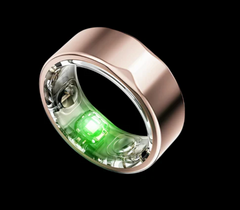
The Halo Ring reads your overnight temperature, sleep and HRV automatically, the signals this article is about, for $250.00.
Meet the Halo RingKai is your AI fertility coordinator, built from 20 years of clinical practice. She can answer your specific questions right now.
Chat with Kai in the app
